Start With the Claim You Need to Check
A photograph, a job title and a description of financial success answer different questions. Treating them as one package makes it easy for confidence in one detail to spill into everything else. A recognizable face does not establish a business history, and a real business history does not establish romantic availability.
Ask yourself what is actually uncertain. Do you need to know whether the person resembles their profile, whether they are available for the kind of relationship they describe, or whether a proposed meeting is practical? Each question calls for a different conversation. Collecting more impressive details is not necessarily the same as reducing the uncertainty that matters.
For affluent dating in particular, avoid letting status become a shortcut. A polished website, luxury photograph or persuasive account of international work may be part of an honest life, but none requires you to skip ordinary boundaries. You are deciding whether to meet a person, not whether their presentation would make a convincing business brochure.
Read Badges as Limited Signals
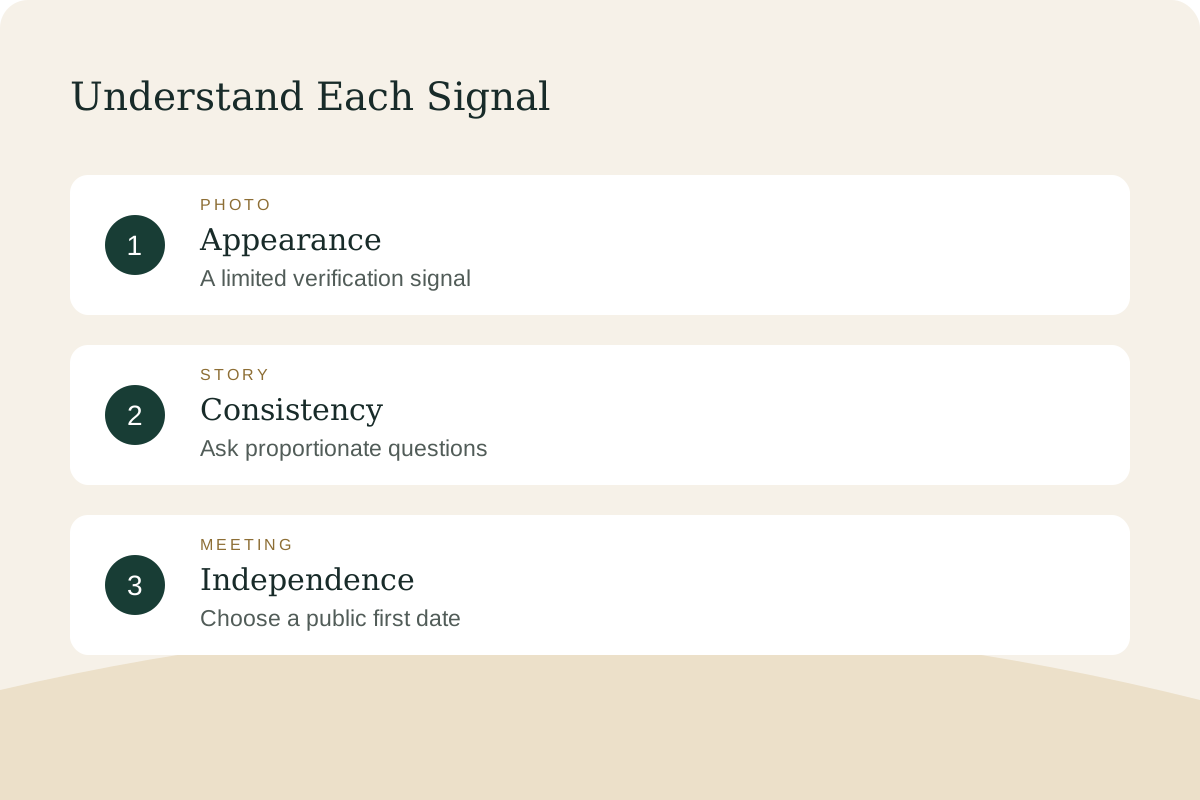
MillionaireMatch's current FAQ says photo verification helps match an account user to submitted photographs. It expressly does not confirm income, occupation, intentions or criminal history. Treat a photo signal as information about the image, not a general endorsement of the person. official verification explanation.
Financial certification and paid membership are separate concepts. If a profile displays several signals, do not combine them into an imagined guarantee. The Certified Millionaire versus photo verification comparison explains their different purposes. A paid tier primarily describes access to platform features, not suitability as a partner.
| What You See | A Reasonable Next Question |
|---|---|
| A photo-verification signal | Does the person I speak with appear consistent with the profile? |
| An impressive career description | Can we discuss ordinary details naturally without turning the date into a credential review? |
| A financial-status claim | Why would this affect the meeting I am considering? |
| A paid membership | Which service features does it provide, rather than what does it say about character? |
Use a Brief Conversation to Reduce Uncertainty
A short live conversation before meeting can make an introduction feel more concrete. Keep it ordinary: discuss the proposed date, a shared interest or the week ahead. It need not become a formal interview, and you do not need to reveal your workplace or home interior to participate.
Choose a neutral background and avoid displaying sensitive information. If video is uncomfortable for either person, discuss the concern rather than immediately assuming deception. Accessibility, privacy and technical difficulties can be real. What matters is whether you can find a mutually comfortable way to make the introduction clearer.
A call is still only one piece of information. Do not regard a pleasant conversation as proof of every claim, and do not use it to justify sending money or sharing documents. It can help you decide whether to take a modest next step, such as a public meeting, without requiring you to settle every question about the person's life.
Look for Consistency Without Invading Privacy
People with public careers may have information available through ordinary public sources. If you consult it, focus on basic consistency rather than compiling an extensive dossier. A business biography can help clarify a public role, but a search result can also be outdated or refer to someone with the same name.
Do not contact employers, clients or family members to investigate a new match. Do not impersonate someone, attempt to access private accounts or pressure a date for confidential documents. Those actions cross boundaries and still do not establish the emotional qualities you are looking for.
If something meaningful does not fit, ask a direct, proportionate question. “You mentioned living locally, but the dates you suggested are all months away—how often are you actually here?” is more useful than silently building a theory. Dating across multiple homes shows why an apparently simple location detail may need explanation without automatically implying dishonesty.
Treat Requests for Proof as a Two-Way Boundary
You are entitled to ask reasonable questions, and the other person is entitled to protect sensitive information. The same applies in reverse. Do not send identity documents, financial statements or account access details to a match because they say they need reassurance. Legitimate platform verification should be handled through the platform's own authorized process.
A request can sound flattering while still being inappropriate: someone may say you seem unusually successful and ask to see evidence, or claim that serious dating requires complete financial transparency immediately. You can decline without supplying an alternative sensitive document. Trust does not begin with surrendering control of your information.
A useful boundary is specific: “I am comfortable having a brief call and meeting in a public place. I do not share financial or identity documents with people I am dating.” If the person cannot accept that, you have information about compatibility regardless of whether their own profile is authentic. Private dating offers ways to remain approachable within clear limits.
Make the Meeting Safe Even If the Story Is True
Suppose every public detail checks out. You still know relatively little about how the person behaves privately. Plan the first meeting so that you retain ordinary independence: choose a public place, arrange your own transport and let a trusted person know your plans.
A private club, home invitation or remote destination should not become mandatory because the other person is recognizable or accustomed to discretion. You can suggest a quieter public setting that respects privacy without placing you entirely in their environment. A considerate match can collaborate on a plan that works for both people.
Keep the first commitment manageable. You do not need to agree to a full weekend because the person has traveled, or accept a ride because it was offered generously. First-date safety deals with the meeting itself; verification is preparation for that decision, not permission to discard its safeguards.
Leave Uncertainty Unresolved When Necessary
Sometimes you will not receive enough information to feel comfortable. You do not have to prove that a person is dishonest before declining a meeting. “I am not comfortable moving forward” is sufficient when the available options do not meet your boundaries.
Distinguish an unanswered question from an accusation. You can end a conversation politely without publishing suspicions or debating the person's character. If there is concrete suspicious behavior or a platform-rule concern, use the service's reporting tools and describe what actually happened rather than adding assumptions.
The aim is proportionate confidence, not perfect certainty. A consistent profile, a respectful conversation and a sensible meeting plan can support a next step. None requires financial dependence, rapid commitment or disclosure of your private life. Let trust grow from repeated behavior after the introduction, while keeping your ability to pause intact.
A profile check cannot guarantee another person's conduct.