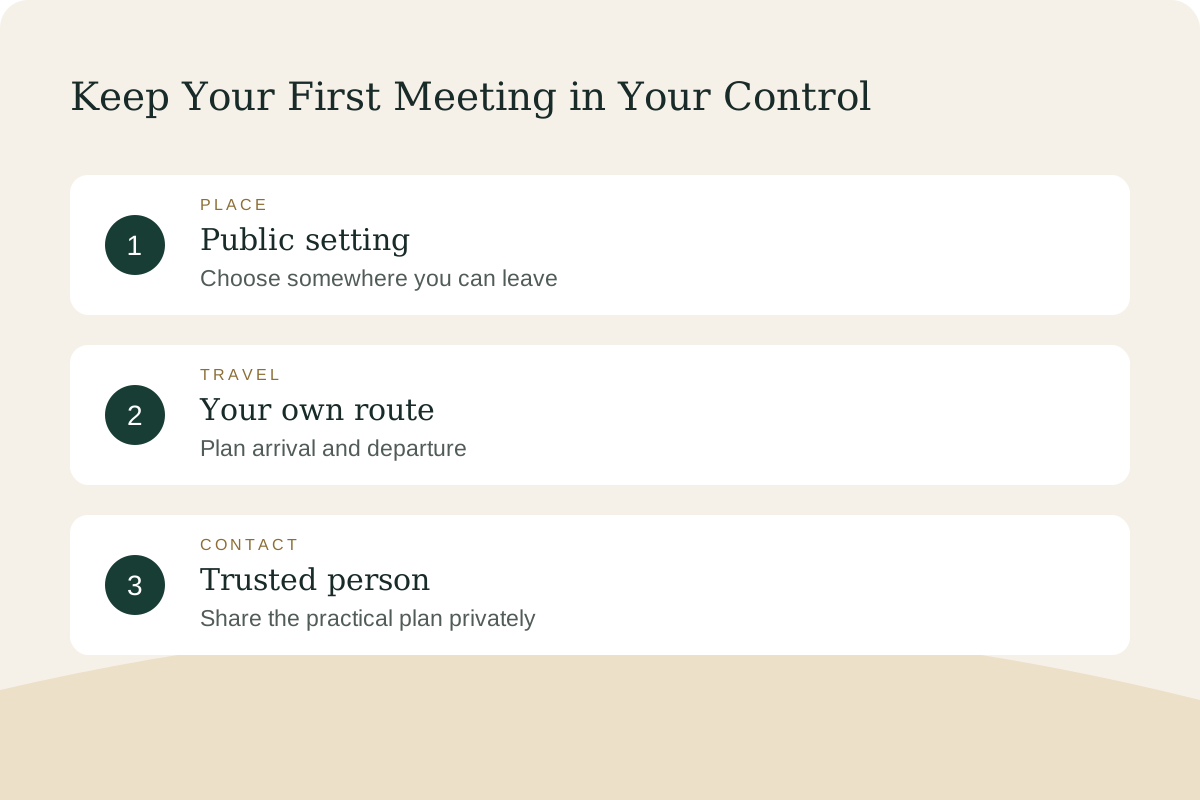
Pick a Place Where You Can Make Your Own Decisions
A suitable venue is one you can find, enter and leave without depending on your date. A public café, restaurant or other staffed setting can allow a relaxed conversation while preserving that independence. Consider the actual environment rather than the prestige of its name.
A private dining room may be elegant but provide less visibility than a normal restaurant table. An invitation to a home, boat or secluded property asks you to accept a different level of dependence. If you are not comfortable, propose an alternative before the meeting rather than hoping the situation will feel easier once you arrive.
Private dating involves choosing what becomes visible, including where an introduction happens. Professional visibility can complicate venue choice. You may prefer somewhere away from your workplace or usual social circle. That preference can be accommodated without choosing an isolated location. Discreet dating for executives explains how to limit professional exposure while retaining practical control of the meeting.
Arrange Arrival and Departure Independently
An offer of a driver or a ride can be thoughtful, but you do not have to accept it on a first date. Arriving independently avoids sharing a home address and makes it easier to leave when you choose. Explain the preference simply; it does not require an accusation or a lengthy defense.
Check your return options before the evening begins. Consider timing, location and whether the service you intend to use will actually be available. A venue that is easy to reach at six may be harder to leave much later. Keep enough practical flexibility that extending the date remains a choice.
If the other person has traveled to meet you, their effort does not create an obligation to stay longer, invite them home or join them at a hotel. Appreciation can coexist with a clear finish. A good first meeting does not need to use every available hour to justify the journey.
Tell One Trusted Person the Practical Plan
Let someone you trust know where you expect to be and when you intend to check in. Share the information privately rather than posting a live location to a broad audience. The purpose is to have a person who can notice if your plans change unexpectedly.
Agree on what a missed check-in means rather than assuming your friend will interpret it correctly. You may simply want them to contact you, or to know how to reach you if you need help. Keep the plan realistic enough that you will actually use it during the evening.
If the date moves to another location, decide whether you genuinely want to go and update your trusted contact. You are allowed to keep the original plan. A spontaneous invitation is not automatically unsafe, but spontaneity should not remove your opportunity to think, decline or preserve your own route home.
Keep Hospitality From Becoming Pressure
An expensive meal can create an unspoken feeling that the guest should be agreeable. Notice that feeling without treating it as a rule. You can decline alcohol, choose a shorter evening or refuse a second venue regardless of who pays. The other person's spending does not change your right to make those decisions.
If you are hosting, make the guest's independence easy. Ask about their preferred setting, explain the plan and accept separate transport. Do not turn a generous offer into a test of trust. A partner's reasonable precautions are not an insult to your character or professional reputation.
A clear response can be brief:
“Thank you for the invitation. I would prefer to meet at the restaurant and make my own way home. That will help me relax and enjoy getting to know you.”
The first-date payment guide discusses the bill itself. Here, the important distinction is between accepting hospitality and accepting expectations that were never mutually agreed.
Pay Attention to How Small Limits Are Received
You may learn more from a response to a simple preference than from another impressive story. Does your date accept your choice of drink? Can you disagree about the next activity without being mocked? Do they ask before changing the plan, or announce that everything has already been decided?
One awkward moment does not require a diagnosis of someone's personality. You can still use your discomfort as a reason to slow down or leave. You do not need to wait for an unmistakable incident before deciding that the evening is no longer right for you.
Keep the focus on your next action. If you feel uncomfortable, move toward staff or another public area, contact someone you trust and arrange to leave. If you face an immediate threat, contact local emergency services. This is a practical response to the situation, not a debate you must win with your date.
Share Enough to Connect Without Exposing Your Routine
A first date can be warm and personal without becoming a detailed map of your life. Discuss interests, values and general work context while keeping home addresses, account details and predictable private routines out of the introduction. You can answer a question at a broader level when the exact detail is unnecessary.
For example, describing the kind of business you run may support conversation without naming confidential clients. Saying that you enjoy a particular neighborhood does not require identifying your building. The aim is to make room for a real connection while allowing trust to develop over time.
If a question feels too personal, redirect it calmly: “I keep that detail private until I know someone better, but I am happy to tell you what I enjoy about the work.” Verification before meeting is useful if you are unsure whether the person is consistent with their profile; a date is not the place to exchange sensitive proof documents.
End the Evening Without Negotiating Your Boundary
Decide when you want to leave and state it clearly. You can have enjoyed the conversation and still prefer to go home alone. If you want another date, say so without agreeing to an immediate extension. If you are undecided, you can take time to reflect before making further plans.
Avoid letting a discussion about whether you are “really interested” replace your decision about the evening. Interest is not measured by surrendering your preferred pace. A person who is compatible with you should be able to hear that you want to stop for the night.
Afterward, consider both attraction and how the meeting felt in practice. Were you able to relax, contribute and make choices? Did the person respect a limit without turning it into a problem? A first date with a millionaire explores the broader relationship judgment once the practical plan has allowed you to meet comfortably.