
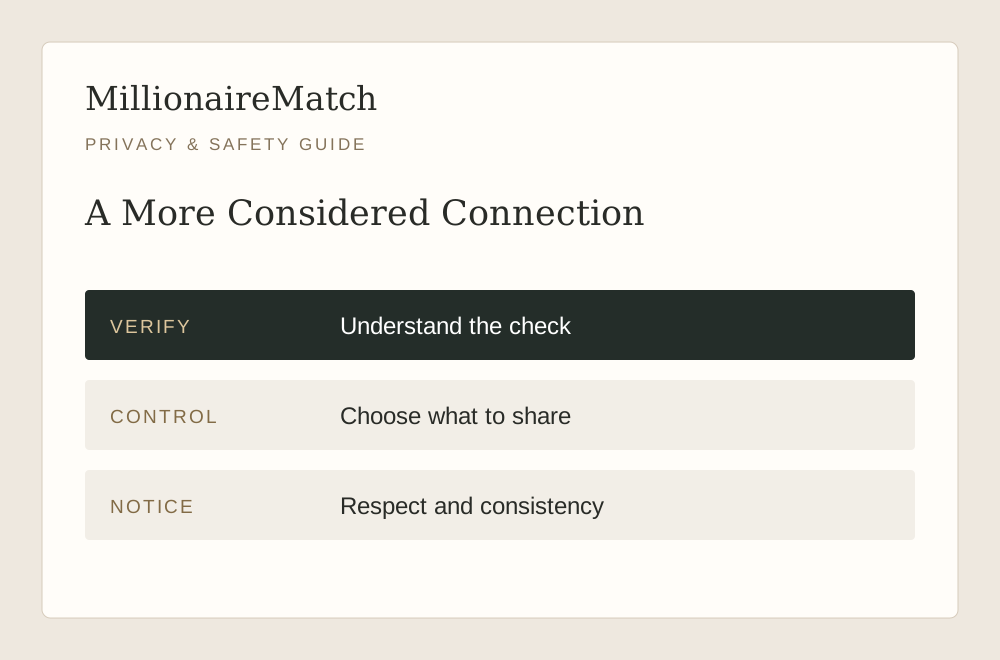
Start With the Limits of Verification
A verification signal is evidence of a particular process, not an assurance about every aspect of a person. The public FAQ distinguishes photo checks from financial information, and the official site states that it does not conduct background checks on members. Do not read a badge as a complete personal history.
This matters in a setting associated with wealth. A polished profile can make an introduction appealing, but it should not make a financial request acceptable. A claimed occupation or a luxury photograph may be interesting context; neither removes the need to evaluate what the person actually asks you to do.
The verification article separates the main signals. Read it before treating “verified” as a single category. Knowing what remains unknown is part of using a check well, rather than a reason to dismiss every useful signal. Private dating for successful singles connects those limits with a gradual, honest introduction.
Share a Person, Not a Complete Identity Record
A dating profile should give enough information for a meaningful introduction. It need not include a precise address, a workplace location, identification documents or details that expose family members. Look at combinations of information, since several ordinary details together can become identifying.
Use photographs that show you accurately without revealing unnecessary background information. Review screens, badges, reflections and other people in the image. A real face and an honest description are compatible with keeping private records out of view.
For executives and founders, professional visibility adds a specific concern. The discreet dating guide provides a staged approach to sharing work identity. Privacy should remain compatible with honesty; inventing a role or becoming evasive about every ordinary question does not create a trustworthy introduction.
Use Album Controls With Realistic Expectations
Private-album tools allow you to choose who receives access within the service. The help material describes both sharing and withdrawal of access. These functions can help you manage disclosure as a conversation develops, but they should not be mistaken for a guarantee that viewed content cannot be copied.
Select private images with the same care you would use for any material another person can see. Avoid sensitive documents, explicit identifying details or photographs involving others without their consent. A private setting changes access inside the product; it does not change the nature of the information.
You can decline an access request or wait until you know someone better. Another member can make the same choice. Pressure to share more than you want is relevant behavior to notice, even if the request is framed as a necessary demonstration of interest.
Understand Visibility Settings Before Relying on Them
The public FAQ describes profile hiding as a Premium capability. Review the current setting in your own account and read what it affects. Search visibility, existing chats and contact with people you approach may behave differently from one another.
Do not assume that a hidden profile erases everything previously visible or that changing one setting ends a subscription. Product controls serve distinct purposes. If you want to stop paying, reduce visibility or remove an account, identify the correct action for each intention.
The membership guide addresses the payment side, and official support can clarify account-specific behavior. A privacy decision is easier to make when the relevant function is understood precisely rather than inferred from a general label.
Keep Financial Boundaries Simple
Do not send money or financial credentials to a person you have only met online. A story involving travel trouble, a business opportunity or an urgent problem can create pressure, but urgency does not establish legitimacy. You are allowed to stop the exchange without resolving the story yourself.
The business-oriented context of MillionaireMatch makes this boundary particularly important. Shared entrepreneurial interests can be a conversation topic; they are not a reason to invest, lend funds or move a dating conversation into a financial scheme. Keep romantic interest and financial transactions separate.
Our article on dating and networking explains how to state that boundary. If the person continues pressing after you decline, use the reporting tools rather than trying to negotiate a safer version of an unwanted request.
Let Calls and Meetings Add Information Gradually
A mutually agreed voice or video call can add context before a meeting. It does not prove everything about a person, but it can help you decide whether the conversation feels comfortable. Choose a time and setting in which you control what is visible and can end the call freely.
For a first meeting, choose a public place, tell a trusted person your plan and retain independent transport. A luxurious invitation is not a reason to skip the steps that would normally help you feel comfortable. You can suggest a simpler venue without apologizing for the preference.
Keep the pace mutual. A respectful person can accept that you are not ready to share an address, travel together or move into a private setting. If the interaction depends on overriding your boundary, that is useful information about whether to continue.
Use Reporting for Behavior That Needs Attention
Report suspicious or inappropriate activity through the service's own tools. Include the relevant profile and a concise account of what happened. Keep supporting material intact where possible, but avoid circulating it publicly or involving unrelated people.
Distinguish facts from conclusions. “The member asked me to transfer money after two conversations” is clearer than a long account of what you think their entire identity might be. The service needs enough context to understand the behavior and apply its process.
The support guide covers useful report details and the difference between this website's editorial contact and the dating service's account team. If there is an immediate threat to your safety, prioritize appropriate local help rather than waiting for an online platform response.
- Identify the relevant profile and the conduct that concerned you.
- Keep the supporting message or image without circulating it publicly.
- Use the service’s reporting route and describe the behavior precisely.
- Prioritize immediate local help if the situation involves an urgent threat.
Read Confidentiality Guard in Its Proper Context
MillionaireMatch publicly describes Confidentiality Guard and restrictions on disclosing or misusing member information. Those policies establish expectations for conduct. They do not make it technically impossible for a person to share something they have seen.
Use the policy as one part of the environment, while keeping your own disclosure proportionate. Do not publish another person's profile, private conversation or dating participation simply because their professional identity is recognizable. The discretion you want should also shape how you treat others.
This guide does not interpret legal remedies or promise a particular outcome from a report. If you need advice about a specific legal problem, the platform's marketing description is not a substitute for qualified guidance on your circumstances.
Keep Confidence and Caution in Balance
You can enjoy a promising introduction without deciding immediately that every detail is proven. Notice consistency, curiosity and respect over time. Let ordinary conversations and manageable meetings supply information that a profile cannot.
Review your settings when your circumstances change. A new role, a move or a developing relationship may alter what you want visible. Likewise, update information that no longer accurately describes your life so another person can make an informed decision about connecting.
The aim is not to remove every uncertainty from dating. It is to keep choices voluntary, information proportionate and product claims understood. Start with a truthful profile, use the available controls carefully and give trust the time it needs.